
T.M. Fowler. "Valley Forge, PA."
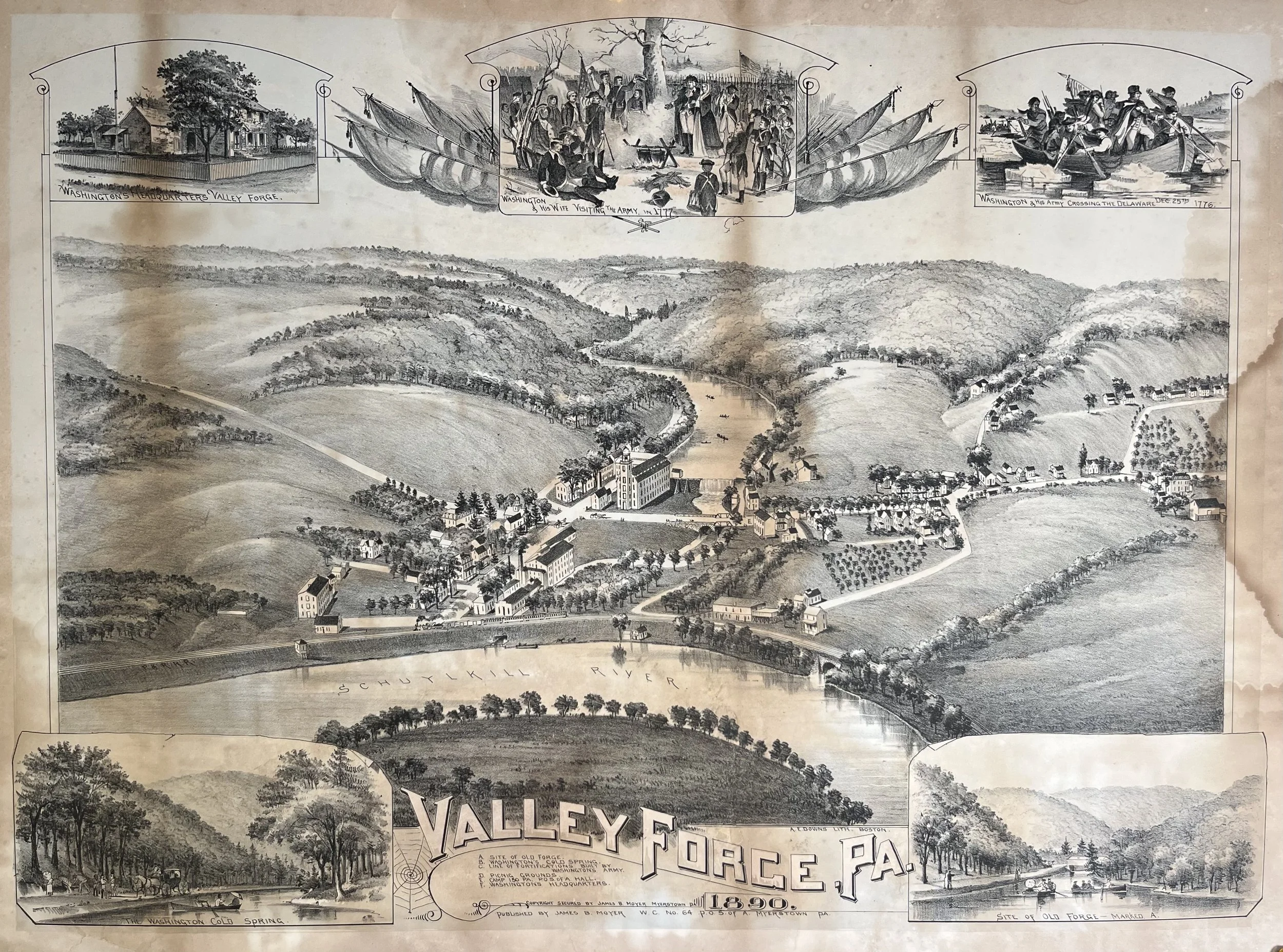
T.M. Fowler. "Valley Forge, PA."
Fowler. “Valley Forge, PA.” Lithograph by A.E. Downs. Boston: ca. 1890. 18 ¾ x 27 inches (image), plus full margins. Heavily stained, but conservation treatments applied to stabilize the paper.
An attractive bird’s-eye view of Valley Forge with the Schuylkill River in the foreground, framed by vignette illustrations along the upper and lower margins. The print highlights Valley Forge’s central role in the American Revolutionary War, where George Washington and the Continental Army encamped from December 1777 to June 1778, enduring a severe winter before emerging as a disciplined fighting force that would go on to victory at the Battle of Monmouth. Owing to its historical importance, the encampment site is now preserved as Valley Forge National Historical Park under the stewardship of the National Park Service.
Six locations are identified in the panorama by a lettered key: Site of Old Forge, Washington’s Cold Spring, the Line of Fortifications Built by Washington’s Army, Picnic Grounds, Camp 150 P.A. P.O.S.A. Hall, and Washington’s Headquarters. Five inset illustrations depict Washington’s Headquarters at Valley Forge; Washington and His Wife Visiting the Army in 1777; Washington Crossing the Delaware, December 25, 1776; the Washington Cold Spring; and the Site of Old Forge.
Produced during the golden age of American bird’s-eye views—roughly from the end of the Civil War through the early 20th century—the print reflects a uniquely imaginative form of cartography created before the advent of aviation. Artists combined city maps, on-site sketches, and Renaissance perspective techniques to construct convincing aerial panoramas that promoted civic pride, settlement, and development. Because such prints were typically issued in relatively small editions and were often treated as ephemeral objects, surviving examples are now scarce.
Thaddeus M. Fowler was among the most prolific and respected creators of panoramic town views in North America, producing more than 400 views over a 54-year career, including over 200 in Pennsylvania alone. Known for his precise renderings and attention to historical and cartographic detail, Fowler worked independently and in partnership with publishers including James B. Moyer, O.H. Bailey, and Thomas J. Bulger. His works are held in major institutional collections, including the Library of Congress and Pennsylvania State University.